Monday, September 26, 2011

They call it Setember over here*


In Costa Rican schools the month of September combines Independence Day, Civics Week, Children's Day, and testing for the end of the second trimester. When I learned that the already short school day would be chopped in half to accommodate dance, theater, choir, and drum practice, as well as tamale making for fundraisers, I despaired that teaching would become impossible. This fear became reality as Children's Day turned out to be a day set aside for eating ice cream, taquitos, and letting children blow whistles and run amok around the school. The teachers had embarked on halfhearted attempts to organize a soccer tournament, but after four subsequent referees were found lacking in either skill or impartiality (my tenure fell victim to the first complaint) the results were annulled and games of tag, hide-and-go-seek, and ring-around-the-rosy ('el barco se hunde' in Spanish) became the norm until lunchtime, when the children were sent home amidst heavy sighs of relief.

Children's Day capped off Civic Week, which took the form of daily school assemblies (the afternoon ones in the blazing sun, or pouring rain) each one focusing on a different part of Costa Rican Patriotism. I was fascinated by everything, from the reasons why a country so rich in birds would choose an unremarkable brown robin as its National Bird (why not a Scarlet Macaw? or a gorgeous Hummingbird? - Answer: its plainness belies its beautiful song), to the history of the 'Escudo' of Costa Rica and its rules of use (one of the first is an odd picture of a man's right chest and arm, without the rest of the body). I think I was the only person who was not bored out of his mind, even the teachers (all gathered under the shade, leaning out only to shush the cooked and miserable students every couple of seconds) were hardly able to stifle their yawns. One of the teachers was so ashamed by the lack of enthusiasm she pointed out that I sang the words of the Costa Rican national anthem, while almost everyone else remained silent. This caused a lot of eye-rolling, but also galvanized the students into a slightly less lackluster performance.

Then came September 15th, which is Independence Day for Costa Rica and most of Central America as well. The story as it is told in Costa Rica is that a brave woman on the night of September 14th, 1821 gathered a group of citizens together in the main square of the capital of Guatemala (then the capital of Central America) to pressure the leaders to declare
independence. They all carried lanterns lit from a single torch, and once the declaration was signed a series of messengers ran with the torch throughout Central America proclaiming Independence, and lighting 'freedom lanterns' in all the houses of the former colony. Costa Rica commemorates that event by having students carry torches throughout the country on the 14th of September, so that at 6 PM that day people gather together at the schools to sing the National Anthem(s) and reenact 'La Noche de los Faroles' (the night of the lanterns).

At a meeting in one of my schools I was voted 'most likely to be able to run a mile' and so became the teacher in charge of shepherding the torch to the school. I knew not what to expect as we walked through the drizzling rain to the bridge where we would meet the torch as it progressed along the entire length of the Peninsula, but I was prepared for the hour and a half of waiting in the rain. The kids and I sang Costa Rican patriotic songs, and I taught them the first few lines of 'America the Beautiful' and 'This Land is Your Land'. Quite suddenly sirens interrupted the pattering of raindrops and a group of bicyclists wearing White, Blue and Red (NOT Red, White, and Blue, as has been pointed out to me on many occasions) screamed by ahead of a small motorcade. First came the District Supervisor's pick-up truck, then a police car, then a small group of students with the torch, and then an ambulance, a bus full of high schoolers who were too tired to continue running, and the large pack of students who took turns running and riding the bus. The torchbearer stopped, handed the torch to a sixth grader who we had chosen to carry it first, and then we were off!

I kept the torch rotating between the different grades, and made sure the order was always boy, girl, boy, girl. Running alongside the sputtering torch through the drizzle was very pleasant, and as we approached the school the sun leapt out and shone on a small crowd of parents that had gathered to watch the arrival of the torch. A small 4th grade girl had the honor of carrying the torch into the school and lighting a larger flame, and everyone gathered round and sang the national anthem. Then the High Schoolers took the torch and set off down the road while the torchbearers from my school and I sped home on our bikes to prepare for the 'Noche de los Faroles' later than evening.

Every child in Costa Rica has to bring a farol (lantern) to the 'Noche de los Faroles', it counts as half of their civics grade every year. Most of them are houses with velum paper over the windows to make the light blue or red. My host niece began planning hers two weeks before, and the final product, although finished hastily hours before the ceremony, followed the plan and turned out well. My host sister made Joan a little farol of his own, to carry at the ceremony.


The sunset that day was graced with a gorgeous double rainbow, with all the colors gradually fading to the vivid pink of tropical pacific sunsets. As the emerging stars pricked the sky to dark blue parents started lighting their children's faroles. The variety was impressive, from Ox-carts to two-story houses, to antique cast iron stormcandles. Unfortunately the eternal curse of nighttime school activities befell this ceremony: as soon as the lights went out control was completely lost. The grand entrance was marred by several teachers each organizing the students differently, and the complicated processions that had been sketchily practiced over the previous weeks fell apart when confronted with groups of parents milling around the makeshift parade ground. All that aside, the beauty of the bobbing lanterns at dusk was always the focus point of the ceremony, and no amount of confusion and frustration could truly ruin such an occasion.

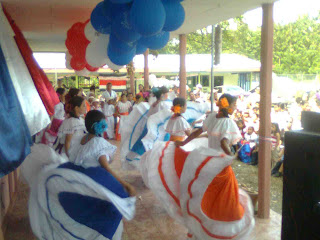
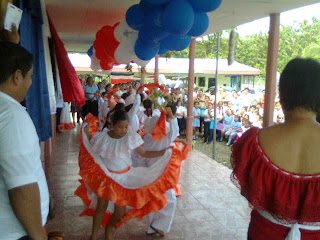
The next day was Independence Day, and I was astonished that everything went off without a problem. We sang the 'Salute to the Flag' and then the 'National Anthem' and then 'Hymn to September 15th' and then the 'Hymn to Juan Santamaría' and then 'Hymn to the Battle of Santa Rosa', those last apparently two just to amp up the level of nationalism at the event, since we had already celebrated those days. All of the songs are beautiful, and the lyrics are quite moving, but they are played far too frequently, and the medley goes on for about 7 minutes too long. The dances were my favorite part of the ceremony, it made me so proud to see my students performing complicated movements, and swishing their long dresses around. I had gone to the first practice to set up the music for the teacher, and seeing how much they improved in such a short time was thrilling. The poetry was adorable, especially when the kindergartner's goggled at the audience and tripped through their lines, even then some of them seemed like trained actors compared to the third grader's stammering stage fright. The ceremony ended with another round of patriotic songs, and everyone went off home.

The most surprising part of all the ceremonies was how little most participants seemed to actually feel patriotic. The songs were sung half-heartedly, less than half of the parents managed to stop their conversations during the national anthem, even fewer knew the words to any of the patriotic songs. In a country with as many things to be proud of as Costa Rica (gorgeous wildlife, a strong democracy, no armed forces, the strongest economy in Central America, a strong system of national parks, etc.) it is odd that displays of patriotism should seem so antiquated and feel so forced. Watching the empty pageantry of another country's nationalism made me realize again how proud I am to be an American.
*Another reason is that we don't usually change the spelling of months - Costa Rica's Royal Academy of Spanish recently pushed through the spelling 'Setiembre' for 'Septiembre'.

Thursday, September 8, 2011

Corcovado: soap no, refried beans yes


Waking up at three in the morning seemed a blessed relief after spending several hours delicately avoiding tossing and turning while jackknifed into a poorly-hung hammock. This was especially true because Kristen and I then stumbled out to the street to begin the long taxi-ride out to Karate to start our trek into one of the most bio-diverse and secluded primary forest reserves in the world.

We were heading to Corcovado National Park, home of tapirs and peccaries, jaguars and mountain lions, tinamous and sparrows, coatis and raccoons, monkeys and armadillos, agouti and squirrels, alligators and rattlesnakes, osprey, pelicans, and harpy eagles. There are more, but the combination between the exotic and the normal (for a Californian) is rather startling at first. We rarely imagine our tawny mountain lion sharing a range with the majestic jaguar, much less slowly replacing it, yet precisely here North America and South America combine and intermix, and 2.5 Million years after their first meeting the intercontinental species swap is still taking place in southern Costa Rica.

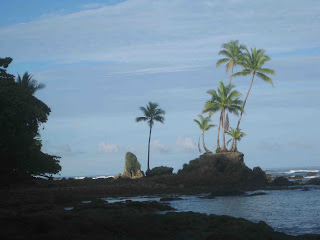
After a several hours in the taxi we emerged at an airstrip on a rather desolate looking stretch of rocky beach. The misty rain that came rippling across the ocean was rather different from the steamy sunrise we feel in our part of the Peninsula, but for the long stretch of beach walking ahead of us it would hard to imagine better weather. As we climbed into the jungle the sun emerged and shone upon our first exotic animal, a poison dart frog! Since then I have seen them at my bus stop and around my schools, but the first viewing is always a wonderful experience. As we trekked through the thickening trees the humidity and heat turned our shirts into sweltering swamps, weighing easily 10 pounds. It was around this time that I realized my water bottle had turned over inside my backpack and slowly emptied out all of the water into my belongings. This was unfortunate for several reasons: first, I was left without water, and second, everything I had brought and not sealed was wet. These both were ultimately minor inconveniences. After several returns to the beach we hit a long stretch of sun and sand, and halfway along water sprung from the cliffs. We were told it was the last water until the Station we would stay at, so I was lucky enough to fill up again and not suffer much thirst.

We had been hiking rather fast, and as we got close to the station we discovered why. We had arrived at a river, not one of the many streams we had already successfully passed but a growing estuary just upstream from the river mouth. The ford was at least 300 feet across and the water quite murky. Our guide told us that every second that passed the water level was rising, so Kristen and I immediately pulled our shoes off, hiked up our pants, and got ready to hoist our bags over our heads, when I asked if there were Crocodiles or Alligators. The guide remained silent as if he hadn't heard us, so Kristen and I started in. I was warily eying the opposite bank and the water all around us, but the more I stubbed my toe on rocks the more I forgot to be scared of aquatic reptiles. Soon we had all crossed successfully, the water only slightly above our waists at the deepest. Once we had all gathered at the other side our guide drew me aside and said simply 'Yes.'

Once we arrived at the station we found that the camping took place on a wood floor elevated about 7 feet off the ground under a roof and connected to the station itself. It was a lot better than I had expected. The station itself was situated at the end of a grassy airstrip with a large well tended lawn, and immediately towering tropical trees jungle jutted up on all sides.

That night we hiked out to another estuary to search for Tapirs, we sat on the riverbank and entertained ourselves by staring at eddies and whirls, playing with hermit crabs, watching various hawks and egrets, and hoping in vain that a large Tapir would come strolling out of the trees and pose on the bank. As the sun sunk into the storm clouds out over the Pacific we began to walk back along the beach. Suddenly, our guide dropped into a crouch behind a log, and began scuttling forward making signs for us to follow quietly. This was very hard to accomplish, and by the time everyone had started to quiet down and look around the tapir had darted back into the forest. Our guide plunged after it, and soon we stumbled upon a mother and baby tapir feeding in a gully. Tapirs are large, with incredibly thick skin, sort of a mix between a rhino and a pig, with a long movable snout that is a little like a short elephant's trunk. The baby was about two years old, and had a massive head. Both tapirs were unconcerned by our presence, aside from a slow moving grazing and occasionally tilting their snouts in our direction and snuffling it was as though we were not there. We got back and ate our hearts out, then turned in.

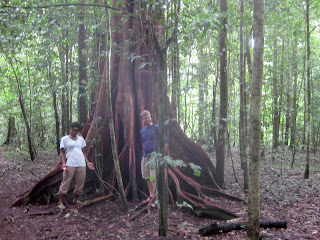
I woke up early and started off into the forest along a short path we had taken the day before. As I walked forward off the airstrip the trees gradually closed in around me and I was fully alone, engulfed in my surroundings, and set adrift in my appreciation of the natural world. The 'jungle' here is not thick with underbrush requiring a machete to move forward. It is not truly jungle either, but rather 'primary moist forest', and the best comparison (it is in fact incredibly similar) is a broilingly hot and humid version of the coastal redwoods in Northern California. in every direction but up open space abounds, interrupted by the occasional bush, small tree, or dangling vine. The forest floor is dappled with leaves and mud, but not swamped by either. The main difference is the ubiquitous presence of monkeys and large parrots, who move with anything but silence and care through the canopy. Forests are often described as Cathedrals, and I can find no better metaphor for the instant respect and reverence that standing in the forest produces. The trees rise mind-boggling heights, their bases buttressed by thick, winding, roots that are taller than people, the sunlight filters down through a thick kaleidoscope of stained leaves and the howler monkeys and tinamous create an eerie, beautifully harmonized choir of gargoyles that explodes through the early morning air. It was magnificent and supremely beautiful.

That afternoon we took a longer hike through the rainforest, and I became pretty good at spotting monkeys (the trick is to wait until you hear a branch hit the ground, then look up). Spider monkey babies, for the record, are adorable. And the fearless leaps their mother's take with little ones hanging on to their backs made me gasp more than once. Howler Monkeys are pretty ugly, but manage to convey a sense of wisdom in their piercing gaze. Sloths are devilishly hard to spot (although my Aunt was very good at it when she came to visit), and wear an expression of perpetual confusion. The cutest animal by far however, was the tamandua, a type of anteater that we saw climbing around in a tree during the hike out. The soles of it's feet are bright pink, and it combed the tree thoroughly, just as frequently upside-down as right-side-up. Watching it stretch its long claws to clasp a new branch was beautiful, if the moment when it suddenly unbalanced and swung forward was startling.

The next morning (my birthday) we started out early and met with a herd of small red brocket deer grazing on the lawn as the newly risen sun lit the delicate mist rising from the grass. As we continued bleary-eyed down the airstrip an iron-flanked and rather un-bellowing he-Tapir clanked and battered across the grass towards us. Pausing momentarily when he heard us, he continued trudging into high grass and the forest, soon lost to view except for the waving tufts of grass billowing in his wake. I thought, Happy Birthday Barton! and kept walking.

Saturday, August 13, 2011

Wedding


Towards the end of April I was asked to participate in a wedding in my host family, one of my host nieces was getting married to her longtime boyfriend, and my host aunt wanted me to escort my host niece (the sister of the bride) down the aisle because "no one else in the family is large enough, and you have a sports coat (esmoquín)." I agreed, pleased to be included as a member of the family, even as a last recourse. Then nothing was mentioned for a month and a half, and the weekend before the wedding I was told that I'd better not have anything planned because I was needed for the ceremony. I was a little taken aback, but as I am never busy it was not a problem.
It took place in a small concrete church that had been beautifully decorated with bamboo and flower arrangements. During the wedding practice we practiced the entrance for an hour or so, and left the exit as a work in progress, which made me pretty nervous. I had little to worry about though, because the pastor did his utmost to ruin the occasion.
I have failed to mention that this niece is 14, several months pregnant, and the groom is 24. The pastor's sermon was about having sex out of wedlock, replete with biblical quotations and a fair amount of personal opinion. My host father, a former pastor, had a startled look on his face when it started, but most of the congregation and families assembled seemed unfazed. Perhaps they are used to ignoring sermons. The bride and groom had smiles painted on, but they were decidedly uncomfortable, and when the end finally came they jumped up a little too quickly, and could hardly wait for all the bridesmaids and groomsmen to clumsily stumble forward and make an arch.
Lunch was served, the church slowly emptied and a handful of relatives (I count myself in their number) along with the bride and groom stayed behind to clean up. When we got home we had wine, ate the wedding cake, and watched soccer on tv. They spent their honeymoon night in the empty room attached to our house where they had lived for two months. Not quite a dream wedding, but I hope that in the pictures you can see that it was a very beautiful occasion. Ultimately it is the spirit of the families involved that make or break an occasion, and the wedding was truly blessed by the people who came to celebrate a joyous union between two people who love one another.

Monday, August 1, 2011

Tamales

Except for my host mother, the most interesting people at my closest school are Genie and Betty. Genie (pronounced Jenny) is the 2nd and 4th grade teacher. She is strict but kind. Betty is the 1st and 5th grade teacher. She is lively and gruff. So, when Genie and Betty invited my host mom and I to come make tamales with them at the janitor's house I could hardly refuse. Betty, who lives 5 hours away, rents a room nearby and goes home every weekend, pulled into the front yard honking repeatedly. When she recognized that we had not ben goaded into moving fast enough she stuck her head out the window and yelled hoarsely 'Vamos, vamos!' We ran to the car through the drizzle (they call it 'pelo de gato' here, literally 'cat's hair') and before we closed the door were bucking down the muddy gravel road towards the street.
"When we arrived they hadn't even killed the pig yet." was the way my host mother described the event to everyone when they asked. It was still squealing and snuffling even while we peeled, chopped, and set to boil the potatoes, carrots, and chiles. By the time the potatoes were fully cooked the chicharrones (pig skin, with fat and, all too frequently, hair) had been fried. I was very surprised by all of this, not least by the fact that I was witness to the pig's demise, and that it was surprisingly simple. I was cleaning off banana leaves in the cooking shed right next to the sty, steeling myself for horrible shrieks and gurgles, but they simply brained the animal with the flat of an axe head, then killed it while unconscious. No sound other than a hollow thunk. The rest seemed little different from what normally happens to chickens at my house on a larger scale. The most terrifying part was that about four of my 1st grade students lived where the pig was killed and were running and jumping about with knives, clearly very excited to be part of cooking for their teachers.
Tamales, like coffee, are one of those things that make me very proud of human ingenuity. The entire process seems very convoluted, involving a lot of aimless chopping, slow stirring, banana leaf cleaning, and very little that looked like the final product. Once the pig fat had been brought over in several pots, we started making the masa (corn dough). When the masa had cooked down to a nice consistency I thought we were ready to start pouring it into the banana leaves, but my host mother just laughed and produced cheese-cloth (really a big of mosquito net folded over itself) to we wring the corn filled-liquid out of the fairly solid mass, making nice dry balls of cornmeal. Of course, we saved the liquid and just threw the cornmeal away, which baffled me. We then cooked the liquid for another hour, by that time the only light in the shed was glowing from the flames massaging the blackened sides of the giant pot where the liquid masa was bubbling and popping.
My host mother crouched low over the seething masa with her back to me, stirring with a giant wooden ladle while singing under her breath, her face turned slowly to gaze at something across the yard and she looked for all the world like a witch straight out of the Dark Ages. In some ways she was working magic. She had molded powder, pig, and water into a liquid that would dry into a moist cake when boiled. In that moment I began to mourn the de-mystification of the kitchen. Now no longer a place of secret spells and potions passed in a codex through the generations of families, but a room of stale whiteness, where the same motions are performed without mystery, frequently without joy. Ever since that night, on the few chances I have had to cook I have been careful to cultivate a sense of wonder and amazement, and to feel quite lucky that through my (real and host) family I have been intimately connected to a body of knowledge that has become vastly under appreciated by modernity.

Tuesday, June 28, 2011

If your familiy´s tried ´em, you know you´ve satisfied ´em

Most weeknights I shuffle myself off to bed a few minutes after 8 o´clock, once I have determined that nothing worthwhile will be on tv. The fact that Costa Rican programming is unexceptional fits in nicely with my 5 AM or earlier wake-up time almost every morning. Weekends are a different matter altogether, most importantly because there is a greater possibility of my host father and I staying up late to watch soccer. I really lucked out in this family because neither my host dad nor I are very discerning. We will delight in any game played at or above the level of the Costa Rican league - essentially everything that is likely to be televised. The problem is that my mother goes to bed almost instantly, although sometimes this is a blessing because she wakes up at 4 to cook breakfast and lunch for my host Uncle.
On non-soccer nights, when Costa Rica´s stations bring out the best they have to offer (´La Pension´ a sitcom about a boarding house in San Jose, ´Nace una Estrella,,´their American Idol, or ´Bailando por un Sueño´their dance program) we stay up together as an extended family and either comment on the action or try to talk over the television. Everyone in my family seems to possess the ability to scream a conversation without considering for a moment lowering the volume or moving to another room. Usually the person trying to watch television has been surreptitiously raising the volume, until the entire house is yelling at ear-splitting levels. I always try to avoid the problem by surrending the remote the moment I sit near it, or capturing it and lowering the volume, but before long the same situation has repeated itself.
The real reason I stay up late is to drink Powdered Milk, which is really quite good. I have found that warm milk right before bedtime is one of the few things that counteract the effects of the incredible volume of coffee I consume throughout the day, and frequently a warm glass of milk will allow me to doze through the bellowed conversations in the living room. In this climate milk goes bad fast, and my host family lived here for years efore they had a refrigerator, so powdered milk is a very common food item, and my host mother has, through years of experience, perfected a mix of sugar and milk powder that has come to completely replace dessert in my diet. Much to my surprise, I have come to prefer warm powdered milk to heated fresh milk, and since the government gives powdered milk to single mothers, and Joan and Yendry spend most of their time at our house, we have a pretty constant demand (and supply) of my favorite nighttime treat.
What Powdered Milk lacks in richness is easily made up for by the texture when it is warmed. Normal milk (unless watched carefully, and that is impossible while the television is on) develops a thick film that can come close to chocking the unweary gulper. The milk we buy here is fresh, and though we separate out the fat, it remains lumpy, a problem solved in Powdered Milk simply by stirring more heartily. This brings me to the chocolate. We make it with unsweetened cocoa powder, sugar, and powdered milk, and it is the best I have had outside of Spain.
On a rainy night few things are better than falling onto your pillow with the warmth in your belly almost making you forget the water dripping on your face.

Friday, May 20, 2011

Without a computer

I have found that since losing my computer, my life here has only changed in positive ways. I spend much more time with my family (albeit watching tv), but I feel even closer to them now than before. The time I spend every day reading has also been greatly augmented, and now that the library is up and running I have access to quite a few good books, and a ton of not-so-good books. Teaching at school has become more enjoyable, if less predictable now that a quarter of the school year is behind us. The students have settled down in most classes, but some of the teachers have stopped showing up regularly. For instance, Fifth grade has not had more than five days of school in the last three weeks.
I am writing several more extensive posts that I hope to be able to put up within a week or so. I am also getting really excited about my parents and aunt and uncle coming down to visit me soon!

Tuesday, May 3, 2011

The Case of the Vanishing Money

My career as the school detective began while I was simply teaching my normal English class. It was First Grade, and the students had just eaten lunch. They were sleepy. Scrapping my plan for a singing competition we began to draw parts of the face and color them in. While I was walking around the room adding eyelashes and trying to figure out how to draw a nose, one girl stealthily slipped out of her seat and crept up to me. We'll call her Charlene, she said nothing, but began tugging at my arm. I asked what the problem was, and she motioned me to move closer. Expecting a petition to drink water or go to the bathroom, I was a little confused by the secrecy. I bent at the waist and lowered my ears to her level, and she cupped her hand and whispered "someone stole all of my ice cream money". Then she scurried back to her seat. I had no idea what to do, so I carried on with the lesson, wondering behind which of these innocent little faces lurked the cold heart of a villain.
I already had my suspicions, a student who I'll call Ramon had been acting fishy all day. While the rest of the class could barely muster the energy to keep their heads up he had been bouncing off the walls. Every time I turned my back he was crawling on the floor to avoid detection, throwing marbles, or trying to grab colored pencils out the hands of the kids sitting behind him. This particular child is a huge discipline problem because whenever notes are sent home his mother complains that he is an angel, and that the teacher must be wrong. That kind of parental shield amounts to the children being entirely uncontrollable, since the only disciplinary measure available is a 'boleta' or note home. When home is unresponsive that is bad enough, but when a boleta can start the process of getting the teacher who writes it sent to a different district, it is a serious issue.
As the children began to emerge from their food comas we started singing 'Head, Shoulders, Knees and Toes' and having competitions between the students in groups of three. First for pronunciation, then for speed. By the fifth round I was dripping with sweat. Meanwhile I had still not decided on a course of action, I had nearly decided not to act. It seemed far more probably that Charlene had simply lost the money. Then, when I was about to close the case forever a witness came forward. One of Charlene's friends (a first grader who had been held back for two years) came forward and said that Ramon had been digging through her backpack in the exact pocket where she had put the money. Now my steel-trap mind whirred into motion. The information was not trustworthy, nor was it enough to sufficiently suspect anyone, but it meant that I had to take the crime seriously. I began to formulate a plan, and so, just when the bell rang I had moved to the back of the room, and was able to slam the iron door shut with a satisfying clang.
A horde of students watched mouths agape as the delighted screams of 'Recess' were swallowed by surprise and silence. Everyone sat down again when I announced sternly that theft had been committed, and that there would be no recess until someone stepped forward and confessed. As I finished speaking I stared directly at Ramon, and he looked away quickly. Seconds ticked by as everyone sat silently, looking around for the culprit. Then, slowly, Ramon got up from his chair and shuffled forward. He whispered his guilt, I opened the gate and everyone ran to recess. His story was quite simple. He had heard Charlene talk about how she was going to buy an icecream cone from the cafeteria with her allowance, so when everyone left for the first 20 minute break, he took the money, ran to the corner store and bought all the candy the money would buy. He ate the goods on the spot, and came to back to school on quite the sugar high. That explained his greater than average excitability, and also fit with the witnesses story. It was good enough for the principal, who sentenced him to a soft reprimand and sent him off to play soccer with all the other students. There were a few holes in the story, since he claimed he had stolen 1,000 colones, and Charlene claimed she only brought 400, and I still don't know if she ever got money back.