Thursday, April 19, 2012

Chirripó


The highest point in Costa Rica is quite cold. This may not be surprising to many people, but before I climbed up Chirripó I had no idea that cold and humid was a climatic possibility, and a miserably tropical one at that. Chirripó is a 3,800 meter peak that lies in the southern half of Costa Rica, near the city of Perez Zeledon, also known as San Isidro del General. I prefer calling it San Isidro, not just because it sounds more traditional, but because San Isidro was the patron saint of Madrid and one of his miracles stemmed from showing up late for work because he had been praying. Everything turned out alright though, because angels were plowing his field for him while he prayed.
There were about 15 people from Peace Corps who showed up to climb together, and we spent the first night right near the trailhead, nestled alongside a stream in a hostel owned by a man from Ojai. I mention this because I walked into the hostel and said 'It feels like Ojai in here', there were large boulders and wood floors and oak leaves covering a rocky stairway down to a swimming hole. The next morning we woke up at 4 and ate breakfast at a nearby restaurant who kindly prepared gallo pinto and scrambled eggs and several fruit platters for us, so that we could leave before 5. My friends Ken and Andrew and I were always non-plussed by the time everyone chose to head out, so we left a little after 5 and quickly enough caught up to the main group. This is not because we were opposed to waking up early, but because hiking in the dark when it is not strictly necessary seems foolhardy.

The trail is generally done in two stages, the first day one hikes 14 kilometers to a dormitory, and the next morning the 5 remaining kilometers to the peak. The 14 kilometer climb on the first day climb about 2,200 meters, seemingly all in the last two kilometers. The trail does start switchbacks while still in the heavily forested lower elevations, but the hardest parts are where it seems to give up on switchbacks, especially in the sandy, slippery sort of places where they would be most helpful. The first part of the hike was gorgeous, a calm steady climb through an autumnal/spring-time forest (brown and orange leaves dying next to new budding flowers). The dappled sunlight and delicate whistles of birdsong were a joy to my ears, which, excepting the grating snatches of music blaring from a fellow hiker's cellphone, were probably the only happy part of my body by the time I reached the dormitory at Crestones. The rest of the trail steepens gradually and just when one is about to give up, flattens out through a burned forest (giving the illusion of breaking through the treeline about three kilometers too early), This part is a pleasant stroll with a beautiful vista, but it ends abruptly at the Cuesta de los Arrepentidos (the Hill of the Repentants) so named because everyone regrets having gone so far only to struggle up an impossibly steep sandy path. We set our teeth and started up, and it was not awful, just a very tiring end to a long hike. After the steep climb the trail rolls smoothly down to the dormitory below.
I was amongst the first group of people to reach the dormitory (we made it in about 6 hours), and after checking in and taking unrefreshingly frigid showers a small group decided to climb up the Crestones, large crenellations of rock jutting out of a low peak above the dormitory. I am still not certain why we thought it would be a good idea to climb a peak between two arduous hikes, but climb we did (Ken and I much more slowly than our two companions). From the top looking down onto the valley with the dormitory the flora was quite different from the alpine growth I have come to expect in the United States. Rather than long meadows of gradually shortening grass growing into rubble and snowy rocks, the Costa Rican Páramo is a burst of low bushes, brambles, flowers and coarse grass, growing all the way up and through massive slabs of granite.

The next morning the we left at 3 am to hike the last 5 kilometers to the top before sunrise, then watch the sun come up over the Caribbean and see our shadows extend out over the Pacific. The moon blocked out all hint of the Milky Way, but it did light our way, so were able to hike for a long time through the freezing dark without flashlights. This was deemed unwise after we lost our way several times. Crunching through ice crystals that would melt into dew with the sun was delightful, although I felt the insides of my ears start to freeze before I was smart enough to put my hood up under my hat. When we rose through the last saddle a massive dark pyramid jutted up into the night sky ahead of us, and from the flashlights glimmering all over it like lightning bugs we realized that it was Chirripó at last. The last part is an easy scramble up one rocky side of the pyramid, and we watched the night sky grow purple in the east as we finally put our flashlights away and pulled ourselves to the top. We had to wait another half-hour for the sun to come up. As it finally rose over a wrinkled sheet of clouds I had the inspiration to sing the Costa Rican national anthem, and was joined by a couple of other volunteers, just as the last strains were fading out over the country the first group of Costa Rican hikers reached the top. I imagine that for them it was magical.

Wednesday, April 11, 2012

Guinness is Good for you


In Costa Rica, March is the cruelest month. Rather than hearing the first whisperings of spring one begins to notice the creeping presence of an anti-autumn. Grass that has been dying since December slowly begins to grow green, a few trees that have lost their leaves during the long hot summer begin to sprout buds and seem to hold the promise of new life, but accompanying these few glimpses of life are newly darkened skies of obese clouds barely able to shift the constipated weight of the rain dammed up inside them. With the clouds come a relieving coolness that signals the first great migration of insects into the house.

But before this change began I travelled into Corcovado for the second time, and the most notable change were the ticks. But the most exciting thing was stumbling into a tapir! We were coming back from a long hike up and down a serrated ridgeline when we heard the monkeys overhead start screaming. We looked up and saw nothing, so we kept going, and as we came around the standing roots of a massive tree we were about 10 feet from a large bull tapir. He twisted his nose around to sniff at us, and then went back to perusing the dry leaves. We stayed and watched him for at least a half hour, until the monkeys came closer, peeing and throwing branches down at us as they came (luckily we were wearing hats).

The major change that has happened in March is that we have acquired a puppy! We gave a puppy to one of my co-teachers when Malta had a litter, and now that dog has had puppies and we got one. I took him home in my backpack, and he's been mine ever since. The first night I had to bring him into bed with me because he wouldn't stop crying from his basket in the laundry room, but slowly he became accustomed to the house and within a week he was sleeping outside with his grandmother. He is (as can be seen from the picture) mostly black with a little frothy rim of beige, so I decided to name him Guinness. My family considers him to be my dog, starting from when I bought him food and medicine and reinforced by the fact that during my absences in the past month he spend his time moping around the house and scratching on my door. When I am around the house he spends most of his time chewing on my toes, or asleep in my clothes.

Wednesday, March 7, 2012

Severance Package

Organizing a 'Castration Clinic' was never on my list of things to do as a TEFL volunteer, but when a volunteer from a site near mine went home, she left me some resources and contacts to organize one in my community. I waited a long time before starting on the project, mostly because teaching 5 days a week leaves me too tired to do much besides be with my host family and read, but during summer vacation (mid-December through mid-February) I went to the vet and found a place to host it. The requirements were surprisingly sparse (water, electricity, something to put up to keep the owner from seeing the dog) and I decided against using the school kitchen (too many committees to go through, and some serious health concerns), and instead chose the Salon Comunal, a rotting wooden structure more reminiscent of a ghost town saloon than a community center. Getting the keys was very easy, though hardly necessary, and the day before the clinic) I went down to prepare the surgery. When I got there I had to excavate about six inches of dirt to get to the water, and confront a giant switch that seemed to spark and shake ominously whenever tried to use it. After clearing some brush away from the door with a machete and cleaning up decorations from a quinceañera I had been to in September, I strolled down to the ocean for a swim, and declared it a successful Valentine's Day, barely mindful of the irony that the next day I would be fulfilling the role of an anti-cupid.


The moment I realized that things would not go as I had planned is hard to pin down, but a definite sinking feeling dropped over me as I came jogging back towards the Salon Comunal with the first dogs of the day, and ran into a herd of cows who instinctively lowered their horns and started huffing while the valiant dogs strained on their rope leashes dragging terrified owners closer to a bovine doom. The moment passed when a group of cowboys rode up whooping and hollering, lashing out with sticks and whips, and the sullen cows started forward. With that first group of dogs came a wonderful woman and her daughter who became the nurses, leaving me the role of receptionist/pharmacist/accountant.


I watched the first couple of operations with interest, marveling at how the veterinarian found the ovaries so quickly, and at how the two nurses unblinking mopped up blood and held the (unconscious) dogs down. Soon I was pulled away by my organizational duties, keeping a weather eye on the appointments and the funds. This would occupy me for the rest of the day, along with one other task: manning the recuperation room.

As the dogs began to recover from the anesthetics they had completely different reactions if they were male or female. The female dogs would shake silently for fifteen minutes, but once they could hold their heads up straight they would stand and begin walking around, ready to go. The male dogs would open their eyes and immediately begin howling and yelping, expressing their woe and causing most owners to come close to tears. They recovered within a half-hour, and began to hobble about until they forgot about the pain. Still, when three or four male dogs were recovering together they would set each other off and the rising and falling harmonies and dissonance was chilling.


The first castration I saw I was puzzled by the intricate series of cuts the doctor made on the testicle before simply popping it out like a grape (at this point in the operation several dogs jumped, even through the sleep produced by four anesthetic shots). I asked him why he made four incisions before removing it, and his response was simply "There is also the whole-ball technique." I had to leave to avoid guffawing. At one point a female dog woke up during the surgery, and without batting an eyelid the doctor put in another shot and kept removing the ovaries. The consummate professional.

As the afternoon wore on the dogs that came were no longer completely fasted. No one out here provides drinking water for their dogs, they simply let the dog drink out of whatever old tire or open sewer is nearby. The vet dealt with full bladders by anesthetizing the dogs, then pressing on their kidneys. Without fail the sleeping dogs began to pee, the first time the vet had not prepared anything so it simply peed on the floor, after that we were all a little more cautious. The trashcan that all the organs and urine went into was a gift basket from the quinceañera, and since trash collection here is spotty at best, I realized as I put in a trash bag outside that dogs and vultures would be sharing some odd meals in the coming days.

Sunday, February 12, 2012

Bulls

From Christmas through Epiphany the airwaves in Costa Rica are dominated by one thing: Bulls. Whether they are being ridden, or simply chasing people around the ring they are Costa Rica's clearest cultural inheritance from Spain, and the closest thing to a national cultural event that this country has. The television spectacle (on both national channels) comes with a 5 person panel of comedians, former riders, and ranch owners, who comment on the action and cover any silences immediately with groans, laughs, yowls, or a popular song apparently named after a legendary bull from years past: 'El Zancudo Loco'.
The event is divided in two parts, the main event of having a man hold on to a leaping behemoth for dear life, and the outrageous time filler of having a slightly smaller bull chase costumed characters and drunk revelers around an enclosed circle. The most important people in the ring are dressed like Superman, Batman, and the entire cast of the 70's television show 'El Chavo del Ocho'. La Chilindra, without fail a man dressed up like a woman, is everyone's favorite, especially when he gets run down and the bull roots around in his skirt. Not content with flashes of antiquated popular culture there are frequently obstacles placed in the ring as well. A favorite seems to be the merry-go-round, but I get a kick out of the four way see-saws because it requires at least two people to recognize when the bull is going to charge to lift one unfortunate participant out of the path of its blunted horns; most often the bull gets frustrated and simply charges the see-saw, throwing everyone onto the ground in a pile. This past year Costa Rica's national bank and major department store both placed cardboard cut outs of cars and boats and trains with their logo prominently placed on the side in the ring, but these were abandoned when bull after bull flipped and then destroyed them in a matter of minutes.
Bull riding is much more suspenseful. One of the greatest differences between the Spanish bullfight and the Costa Rican rodeo is that in Costa Rica the bulls become famous: El Malacrianza, El Chirichi, El Coloradilla, El Soldado (I just asked my host father to tell me some famous bulls, and without pausing he rattled off this list). Because they survive from event to event they are far more interesting than the people who ride them, who frequently suffer serious injuries and so make up a rather transient bunch.
In a typical event the camera focuses in close on the top of the pen as the rider lowers himself onto the animal's back. Then he jumps off, the camera patiently watching his boots. Once he is back on again the bull starts bucking, throwing the rider against the metal poles that line his pen. This process can take upwards of 10 minutes, so it usually starts while the smaller bull is chasing people around. Once everything is ready and the other bull has been retired, the gate flies open and nearly a ton of muscle vaults out and begins spinning and jerking wildly. The bull has two cinches around its middle, the first is for the rider to hang on, and the one nearest the back keeps the back legs kicking together, effectively disabling the creature from running. Most riders fall off within 5 seconds, but some are able to ride until the bull slows down and stops. Serious injuries are surprisingly low, the most dangerous seems to be when successful riders have to dismount, because the bull frequently feels the change in weight and starts bucking and charging, frequently flipping the victorious rider onto the ground and then pawing at him. When I went to a bullring in a small town a few weeks ago the rider managed to tackle the bull around the neck with his legs, bringing them both crashing to the ground, the bull slightly more confused than the rider.
There are two different types of bulls as well, the ones used for the comic segment tend to be straightforward Western cattle, thick and essentially cow shaped. The riding bulls however are 'Brahma' bulls, featuring large humps above the shoulders, long flapping ears, and horns that tend to be more vertical than otherwise. These are the cows I associate with antiquity, they are featured in Babylonian carvings and Egyptian papyruses, and they seem far more noble, if similarly unintelligent. This second type is the most common in Costa Rica's lowlands, making nuisances of themselves by filling up school yards, blocking roadways, and devouring people's gardens.
My host sister's son is enthralled by watching these events, and he has taken to flipping over a chair in the front yard and sitting on the seat gyrating screaming 'la mano libre!' in emulation the bull riders on television. He still loves hopping up and down on his grandfather's legs gripping his knees so as not to be bucked, whooping and yelling all the while.
Last night as we were watching the trumpet sounded for the last bull, everyone's attention was riveted on the starting gate, except for one woman walking along peacefully directly in front of the bull pen. The doors flew open and the bull ran her over before either of them knew what was happening. The woman got up shakily, dusted herself off, and kept walking.

Sunday, December 18, 2011

We Wish You a Merry Christmas

After two months of intermittent training I was finally ready to bury my Christmas Chorus. I had just come back from a week of training in San Jose, graduation was in 3 days and I was sure not only that my students had forgotten the song, but also that the principal, who had never been too interested, had forgotten about the Chorus' existence. I was surprised when I walked into her office that morning and was informed that my choir was the only thing anyone had prepared for graduation, that we were performing in three days, and that I needed to call everyone immediately and have a practice in an hour and a half.
Such was my brusque welcome to the little discussed dark side of the 'pura vida' atmosphere: the sudden virulent panic that sets in before anything important happens. I threw myself in with gusto, making this week of school parties and graduations the busiest week of school I've had in months. One night I spent four hours inflating balloons, I helped my host mother clean the school kitchen, and we practiced. Different groups of students showed up every day, and I was not told a definite time for the graduation until the day before.
It was raining hard the day of the ceremony, and I was surprised that when I got to school a swarm of ready chorus members surrounded me as I pulled off my rain clothes. I started to get more and more nervous as the time came for my students to perform. As the ceremony wore on parents started grumbling in the back, the song was the last thing on the schedule. When the time came I sprang up with my songsters, organized them quickly, turned on the music, and they started singing.


I could not be more proud of them.

Merry Christmas, Everyone.

News from Nowhere


Whenever I arrive at my most distant school after a long bike ride I like to go to the little store nearby for a cup of coffee to re-energize me before class starts. While I was gingerly sipping the from the steaming cup, one of my student's grandfather approached me cautiously and asked permission to ask me a question. He pressed a coin into my palm and asked me what country it was from. I studied the engraved animal on the front and the writing on the back and told him about a magical place where pizza flows like water and video-arcades make children into the very zombies they are so desperately killing. The coin was from Chucky Cheese.


A little while ago our neighbor broke the glass part of the coffee machine again. This time it wasn't her two year old crawling over the top of the sofa, it was the 12 year-old smashing it down on the counter after filling his thermos for the afternoon shift of his construction job. The neighbor promised to pay for it, but it would take her a few months to save up the money. In the interval we introduced a new form of making coffee, not the traditional way of pouring it through a hanging filter (because boiling the water means spending money on gas, or taking the effort of lighting the wood stove), instead we first poured the water into a pot that fit under the coffee maker. Next we transferred the water to an aluminum pitcher, so that we could pour it into the coffee machine without spilling. Then the normal coffee process took place. Once all the coffee was in the pot, we poured it back into the pitcher to transfer it into the thermos so that it wouldn't get cold. Once it got 'stale' (after 3 hours) the process would start anew. In October I spent the majority of my time outside of school making coffee.


My host uncle was trying to become a real estate agent. He somehow made a connection with a lawyer in San Jose who wanted to buy land for a hotel, and desperately trying to get him interested in buying a plot of land above my neighborhood. "In order to seal the deal I just need to send him some pictures, especially of the ocean view" he complained. I agreed to help him send the pictures he took with his cellphone, but the quality was too low for the lawyer. Since I was already involved I soon found myself riding my bike up past the creek with my camera to take pictures that the lawyer could actually use. The owner, a very sweet man whose family hosted Peace Corps volunteers in the 1970s, walked me all around the property. He took me to see some surreal insects that have only been documented inside the National Park, and we walked around to where his friend had placed some butterflies in chrysalis. We happened to be there when several of them were hatching out and spreading their wings. Then, on the way back we ran into a group of Squirrel Monkeys (the cutest monkeys). I had no idea that so much of what I had most loved about Corcovado was only about 20 minutes from my house. The lawyer was unimpressed. It turned out he was looking for property in an entirely different part of the country. More fool him.

Saturday, November 19, 2011

A-a-azul, A-a-azul!

A new craze has swept Costa Rica in the unlikely colors of blue and orange. Few and far between are the schools where breathless chants of 'A-a-azuul' and 'naran-ja, naran-ja' do not fill the air as rival bands of students act out the feats they saw the night before on TV. The source of this color-borne enmity is a weeknight (two hours a night, Monday-Friday) television program called Combate that is currently outperforming the nightly news and various novelas and gameshows on both of Costa Rica's major stations. The show features two teams of contestants who gather points every night in various contests of fitness and agility. The two teams are (you guessed it) orange and blue and have six members each, three men and three women. The contestants are fit, attractive, and dressed in spandex which alone is probably responsible for its popularity. Each team has its own song, its own dance, and its own captain, and every two weeks one person is voted off one team only to be replaced the very next day by a new recruit.


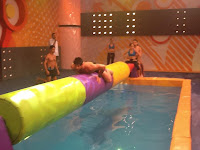
One contest they do almost every night is called 'cilindros' and the contestants have to move above a pool across large cylinders that spin and frequently send people splashing into the water. The contest that is most frequently acted out a school is 'resistencia' where four contestants interlock their bodies and have to remain suspended on each other's laps with only their legs touching the ground as chairs are removed, and stay for at least 3 minutes. I was quite thrilled when a group of 5th graders (including my host niece) beat the sixth graders at one of my schools before that particular contest was banned.


In my host family my host niece immediately picked the blue team, while my host sister and the indigenous students picked orange. My host parents were loath to take sides in the beginning, but the blue team has won them over as well. The entire country is polarized, the kindergarten teacher at school recently lined up all her students and had them do the Blue team's dance, until several of the little kids rebelled and ran across the schoolyard to do the orange dance. Every night my host niece gets excited, asking me every couple of minutes what time it is, so that she can change the channel to Combate before my host father turns the news on. I have found that knowing the names of the contestants on Combate has given me a lot more credibility with my students, and armed me with a constant topic of conversation at recess, which has been instrumental in establish rapport and keeping class going as the school year collapses around us.

What makes the show interesting for me is how openly and artlessly it addresses itself as a reality-tv show. When the captain of the Orange team was growing too belligerent they switched the team's captains, thereby shaking many people's loyalty. A large number of people had joined the blue team precisely because the orange team's captain was so unpleasant. Now they found themselves having to support the person they hated, or admit to themselves that in reality, it was simply a pointless television show. Very few audiences are put through such a traumatic breaking of the fourth wall, and I am proud to say that most of Costa Rica had little trouble keeping their disbelief suspended. The two announcers enter into conversations with the manager at least twice an episode and the manager seems to make important decisions on the spur of the moment. The most memorable night was when the hated captain overstepped his contract and threatened to quit. He was told immediately that threatening to quit meant immediate dismissal, and was escorted offstage within seconds. The show's directors then appointed a new captain (the best friend and roommate of the other team's captain) and so it goes.