From Christmas through Epiphany the airwaves in Costa Rica are dominated by one thing: Bulls. Whether they are being ridden, or simply chasing people around the ring they are Costa Rica's clearest cultural inheritance from Spain, and the closest thing to a national cultural event that this country has. The television spectacle (on both national channels) comes with a 5 person panel of comedians, former riders, and ranch owners, who comment on the action and cover any silences immediately with groans, laughs, yowls, or a popular song apparently named after a legendary bull from years past: 'El Zancudo Loco'.
The event is divided in two parts, the main event of having a man hold on to a leaping behemoth for dear life, and the outrageous time filler of having a slightly smaller bull chase costumed characters and drunk revelers around an enclosed circle. The most important people in the ring are dressed like Superman, Batman, and the entire cast of the 70's television show 'El Chavo del Ocho'. La Chilindra, without fail a man dressed up like a woman, is everyone's favorite, especially when he gets run down and the bull roots around in his skirt. Not content with flashes of antiquated popular culture there are frequently obstacles placed in the ring as well. A favorite seems to be the merry-go-round, but I get a kick out of the four way see-saws because it requires at least two people to recognize when the bull is going to charge to lift one unfortunate participant out of the path of its blunted horns; most often the bull gets frustrated and simply charges the see-saw, throwing everyone onto the ground in a pile. This past year Costa Rica's national bank and major department store both placed cardboard cut outs of cars and boats and trains with their logo prominently placed on the side in the ring, but these were abandoned when bull after bull flipped and then destroyed them in a matter of minutes.
Bull riding is much more suspenseful. One of the greatest differences between the Spanish bullfight and the Costa Rican rodeo is that in Costa Rica the bulls become famous: El Malacrianza, El Chirichi, El Coloradilla, El Soldado (I just asked my host father to tell me some famous bulls, and without pausing he rattled off this list). Because they survive from event to event they are far more interesting than the people who ride them, who frequently suffer serious injuries and so make up a rather transient bunch.
In a typical event the camera focuses in close on the top of the pen as the rider lowers himself onto the animal's back. Then he jumps off, the camera patiently watching his boots. Once he is back on again the bull starts bucking, throwing the rider against the metal poles that line his pen. This process can take upwards of 10 minutes, so it usually starts while the smaller bull is chasing people around. Once everything is ready and the other bull has been retired, the gate flies open and nearly a ton of muscle vaults out and begins spinning and jerking wildly. The bull has two cinches around its middle, the first is for the rider to hang on, and the one nearest the back keeps the back legs kicking together, effectively disabling the creature from running. Most riders fall off within 5 seconds, but some are able to ride until the bull slows down and stops. Serious injuries are surprisingly low, the most dangerous seems to be when successful riders have to dismount, because the bull frequently feels the change in weight and starts bucking and charging, frequently flipping the victorious rider onto the ground and then pawing at him. When I went to a bullring in a small town a few weeks ago the rider managed to tackle the bull around the neck with his legs, bringing them both crashing to the ground, the bull slightly more confused than the rider.
There are two different types of bulls as well, the ones used for the comic segment tend to be straightforward Western cattle, thick and essentially cow shaped. The riding bulls however are 'Brahma' bulls, featuring large humps above the shoulders, long flapping ears, and horns that tend to be more vertical than otherwise. These are the cows I associate with antiquity, they are featured in Babylonian carvings and Egyptian papyruses, and they seem far more noble, if similarly unintelligent. This second type is the most common in Costa Rica's lowlands, making nuisances of themselves by filling up school yards, blocking roadways, and devouring people's gardens.
My host sister's son is enthralled by watching these events, and he has taken to flipping over a chair in the front yard and sitting on the seat gyrating screaming 'la mano libre!' in emulation the bull riders on television. He still loves hopping up and down on his grandfather's legs gripping his knees so as not to be bucked, whooping and yelling all the while.
Last night as we were watching the trumpet sounded for the last bull, everyone's attention was riveted on the starting gate, except for one woman walking along peacefully directly in front of the bull pen. The doors flew open and the bull ran her over before either of them knew what was happening. The woman got up shakily, dusted herself off, and kept walking.
Sunday, February 12, 2012

Sunday, December 18, 2011
We Wish You a Merry Christmas
After two months of intermittent training I was finally ready to bury my Christmas Chorus. I had just come back from a week of training in San Jose, graduation was in 3 days and I was sure not only that my students had forgotten the song, but also that the principal, who had never been too interested, had forgotten about the Chorus' existence. I was surprised when I walked into her office that morning and was informed that my choir was the only thing anyone had prepared for graduation, that we were performing in three days, and that I needed to call everyone immediately and have a practice in an hour and a half.
Such was my brusque welcome to the little discussed dark side of the 'pura vida' atmosphere: the sudden virulent panic that sets in before anything important happens. I threw myself in with gusto, making this week of school parties and graduations the busiest week of school I've had in months. One night I spent four hours inflating balloons, I helped my host mother clean the school kitchen, and we practiced. Different groups of students showed up every day, and I was not told a definite time for the graduation until the day before.
It was raining hard the day of the ceremony, and I was surprised that when I got to school a swarm of ready chorus members surrounded me as I pulled off my rain clothes. I started to get more and more nervous as the time came for my students to perform. As the ceremony wore on parents started grumbling in the back, the song was the last thing on the schedule. When the time came I sprang up with my songsters, organized them quickly, turned on the music, and they started singing.
I could not be more proud of them.
Merry Christmas, Everyone.
Such was my brusque welcome to the little discussed dark side of the 'pura vida' atmosphere: the sudden virulent panic that sets in before anything important happens. I threw myself in with gusto, making this week of school parties and graduations the busiest week of school I've had in months. One night I spent four hours inflating balloons, I helped my host mother clean the school kitchen, and we practiced. Different groups of students showed up every day, and I was not told a definite time for the graduation until the day before.
It was raining hard the day of the ceremony, and I was surprised that when I got to school a swarm of ready chorus members surrounded me as I pulled off my rain clothes. I started to get more and more nervous as the time came for my students to perform. As the ceremony wore on parents started grumbling in the back, the song was the last thing on the schedule. When the time came I sprang up with my songsters, organized them quickly, turned on the music, and they started singing.
I could not be more proud of them.
Merry Christmas, Everyone.
News from Nowhere

Whenever I arrive at my most distant school after a long bike ride I like to go to the little store nearby for a cup of coffee to re-energize me before class starts. While I was gingerly sipping the from the steaming cup, one of my student's grandfather approached me cautiously and asked permission to ask me a question. He pressed a coin into my palm and asked me what country it was from. I studied the engraved animal on the front and the writing on the back and told him about a magical place where pizza flows like water and video-arcades make children into the very zombies they are so desperately killing. The coin was from Chucky Cheese.

A little while ago our neighbor broke the glass part of the coffee machine again. This time it wasn't her two year old crawling over the top of the sofa, it was the 12 year-old smashing it down on the counter after filling his thermos for the afternoon shift of his construction job. The neighbor promised to pay for it, but it would take her a few months to save up the money. In the interval we introduced a new form of making coffee, not the traditional way of pouring it through a hanging filter (because boiling the water means spending money on gas, or taking the effort of lighting the wood stove), instead we first poured the water into a pot that fit under the coffee maker. Next we transferred the water to an aluminum pitcher, so that we could pour it into the coffee machine without spilling. Then the normal coffee process took place. Once all the coffee was in the pot, we poured it back into the pitcher to transfer it into the thermos so that it wouldn't get cold. Once it got 'stale' (after 3 hours) the process would start anew. In October I spent the majority of my time outside of school making coffee.

My host uncle was trying to become a real estate agent. He somehow made a connection with a lawyer in San Jose who wanted to buy land for a hotel, and desperately trying to get him interested in buying a plot of land above my neighborhood. "In order to seal the deal I just need to send him some pictures, especially of the ocean view" he complained. I agreed to help him send the pictures he took with his cellphone, but the quality was too low for the lawyer. Since I was already involved I soon found myself riding my bike up past the creek with my camera to take pictures that the lawyer could actually use. The owner, a very sweet man whose family hosted Peace Corps volunteers in the 1970s, walked me all around the property. He took me to see some surreal insects that have only been documented inside the National Park, and we walked around to where his friend had placed some butterflies in chrysalis. We happened to be there when several of them were hatching out and spreading their wings. Then, on the way back we ran into a group of Squirrel Monkeys (the cutest monkeys). I had no idea that so much of what I had most loved about Corcovado was only about 20 minutes from my house. The lawyer was unimpressed. It turned out he was looking for property in an entirely different part of the country. More fool him.

Saturday, November 19, 2011
A-a-azul, A-a-azul!

A new craze has swept Costa Rica in the unlikely colors of blue and orange. Few and far between are the schools where breathless chants of 'A-a-azuul' and 'naran-ja, naran-ja' do not fill the air as rival bands of students act out the feats they saw the night before on TV. The source of this color-borne enmity is a weeknight (two hours a night, Monday-Friday) television program called Combate that is currently outperforming the nightly news and various novelas and gameshows on both of Costa Rica's major stations. The show features two teams of contestants who gather points every night in various contests of fitness and agility. The two teams are (you guessed it) orange and blue and have six members each, three men and three women. The contestants are fit, attractive, and dressed in spandex which alone is probably responsible for its popularity. Each team has its own song, its own dance, and its own captain, and every two weeks one person is voted off one team only to be replaced the very next day by a new recruit.
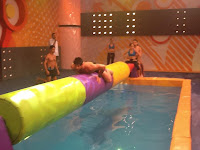
One contest they do almost every night is called 'cilindros' and the contestants have to move above a pool across large cylinders that spin and frequently send people splashing into the water. The contest that is most frequently acted out a school is 'resistencia' where four contestants interlock their bodies and have to remain suspended on each other's laps with only their legs touching the ground as chairs are removed, and stay for at least 3 minutes. I was quite thrilled when a group of 5th graders (including my host niece) beat the sixth graders at one of my schools before that particular contest was banned.

In my host family my host niece immediately picked the blue team, while my host sister and the indigenous students picked orange. My host parents were loath to take sides in the beginning, but the blue team has won them over as well. The entire country is polarized, the kindergarten teacher at school recently lined up all her students and had them do the Blue team's dance, until several of the little kids rebelled and ran across the schoolyard to do the orange dance. Every night my host niece gets excited, asking me every couple of minutes what time it is, so that she can change the channel to Combate before my host father turns the news on. I have found that knowing the names of the contestants on Combate has given me a lot more credibility with my students, and armed me with a constant topic of conversation at recess, which has been instrumental in establish rapport and keeping class going as the school year collapses around us.
What makes the show interesting for me is how openly and artlessly it addresses itself as a reality-tv show. When the captain of the Orange team was growing too belligerent they switched the team's captains, thereby shaking many people's loyalty. A large number of people had joined the blue team precisely because the orange team's captain was so unpleasant. Now they found themselves having to support the person they hated, or admit to themselves that in reality, it was simply a pointless television show. Very few audiences are put through such a traumatic breaking of the fourth wall, and I am proud to say that most of Costa Rica had little trouble keeping their disbelief suspended. The two announcers enter into conversations with the manager at least twice an episode and the manager seems to make important decisions on the spur of the moment. The most memorable night was when the hated captain overstepped his contract and threatened to quit. He was told immediately that threatening to quit meant immediate dismissal, and was escorted offstage within seconds. The show's directors then appointed a new captain (the best friend and roommate of the other team's captain) and so it goes.
Sunday, October 30, 2011
Leaving Fingerprints

When I woke up on Thursday morning I already knew there would not be school. I had been warned that very little happened in Costa Rican schools from October to December (the end of the school year) but I was completely unprepared for showing up on Tuesday and finding out that it was a half day, and that we had the entire rest of the week off. To combat the sudden and frequent lack of school, the principal has begun to organize a group of students who come together on some of the days off and do things to help the school. The group is called 'Dejando Huella' which is correctly translated as 'Leaving a Footprint' but I like much better as 'Leaving Fingerprints'. One day they cleaned up the schoolyard, another day they designed a logo for the school, and on this particular day I was coming in to organize a group of students to sing Christmas Carols at graduation. The principal came up to me outside of the classroom and told me to make a list of all the students who had come, and then whittle it down to those who did best at English and would not act out. After about an hour of sitting in the meeting working on the list I had failed at my task. As I told the principal, if I limited it to the students who were both good at English and didn't misbehave I would have no boys in the chorus, so we decided to present the idea to the whole group, and then hope that the number of participants did not drop below 8. Before I could present the idea of the chorus though, the students were sent out on their project for the day.*
That day the students had come to walk door-to-door to raise money for a school garden. When I found out that one group of students would have to walk with the physical therapy teacher all the way back to my neighborhood (about 6km there and back) I volunteered to accompany them. I was supposed to make sure that the students each took turns asking for money at the houses, and that they stuck within the parameters of the basic script. Also, I was supposed to save them from peril, and from early on the fearsome visage of a massive dog haunted my mind. Luckily, the first large dog we encountered was a labrador I knew. While the kids cowered behind me I strode up purposefully talking in a "good doggie, thats a goodboy, youaresuchagooddog!" sort of voice. Chester (the dog) immediately waddled forward happily and let me pat him while the kids went through their spiel. The delicate balance I had established between man and nature nearly collapsed however when the jittery children decided to sprint back to the street past the dog. Chester was confused, but some sweet words from my end convinced him not to chase the kids. This experience early on had the unfortunate effect of making the kids believe that I wasn't absolutely terrified of dogs, so at several other houses I was suddenly left alone facing large dogs while my pupils scurried past me to safety. Since I am in the Peace Corps, and am supposed to model good behavior, I thought it would be bad to simply throw rocks (the Costa Rican response to most dogs), but also bad to just run away. This left me frequently in a wobbly kneed stance trying to convince the dogs that I was their friend using the voice mentioned above. The dogs were rarely convinced. They were confused though, and generally seemed to shake their heads in wonder and trot away. The physical therapy teacher, for each of these encounters, and for most of the walk, stayed back dawdling and generally being unhelpful.
Aside from dogs, the other major problem we had was mud. It is the rainy season in Costa Rica (otherwise known as October) and most of the streets are covered in several inches of muck. In another miraculous victory over nature, not a single flip-flop was broken, and not a single shoe lost, although not a soul escaped without very muddy feet. By the time we got near my house they had already lost one (empty) change box in a large mudpuddle, so I walked in and brought out mine, with about 6 months of collected change in it (I have periodically rooted through it and pulled out all the 500 colon coins for bus fare). Being wise panhandlers they promptly emptied out all the change from my see-through jar into the remaining box so that it would seem like they were having a rough time and get more pity.
I did have some moral qualms about the whole process, especially because I live in the poorest neighborhood of my town, and going door-to-door at times felt like shaming people who have next to nothing into giving money to an abstract cause they had no interest in. This came up only once in conversation amongst the students though, and they quickly convinced themselves that it did not matter. On the way back to the school we stopped and I bought everyone popsicles, which proved to be an excellent decision, because it relieved thirst and made it so that not even the two little third grade boys complained. They had enough energy left to race me the last 100 meters to the school.
When we got back and counted the money our group brought back I was staggered to see that it came up to 29,000 colones (about $60). In total, all the groups raised about $160. I was still not sure what we had raised so much money to do, and the students were not too clear about it either. When I asked, the principal told me that the money was to pay for concrete and cinderblocks for the garden. Concrete and cinderblocks do not quite sound like a recipe for a garden, but then again in Costa Rica it is impossible to keep any spot of land free of plants, so brick and concrete are probably just as good as soil, and fit better into Costa Rican aesthetics. The Costa Rican 1,000 colon bill ($2) had a concrete building on the back. The bill was gorgeous, the building less so. Now they have changed it for a deer and a tree (the national animal and tree) which is a little less revealing about the culture.

*There will be more about the chorus if it actually happens, the first practice will be on Tuesday, another inexplicable day off from school.
Monday, September 26, 2011
They call it Setember over here*

In Costa Rican schools the month of September combines Independence Day, Civics Week, Children's Day, and testing for the end of the second trimester. When I learned that the already short school day would be chopped in half to accommodate dance, theater, choir, and drum practice, as well as tamale making for fundraisers, I despaired that teaching would become impossible. This fear became reality as Children's Day turned out to be a day set aside for eating ice cream, taquitos, and letting children blow whistles and run amok around the school. The teachers had embarked on halfhearted attempts to organize a soccer tournament, but after four subsequent referees were found lacking in either skill or impartiality (my tenure fell victim to the first complaint) the results were annulled and games of tag, hide-and-go-seek, and ring-around-the-rosy ('el barco se hunde' in Spanish) became the norm until lunchtime, when the children were sent home amidst heavy sighs of relief.
Children's Day capped off Civic Week, which took the form of daily school assemblies (the afternoon ones in the blazing sun, or pouring rain) each one focusing on a different part of Costa Rican Patriotism. I was fascinated by everything, from the reasons why a country so rich in birds would choose an unremarkable brown robin as its National Bird (why not a Scarlet Macaw? or a gorgeous Hummingbird? - Answer: its plainness belies its beautiful song), to the history of the 'Escudo' of Costa Rica and its rules of use (one of the first is an odd picture of a man's right chest and arm, without the rest of the body). I think I was the only person who was not bored out of his mind, even the teachers (all gathered under the shade, leaning out only to shush the cooked and miserable students every couple of seconds) were hardly able to stifle their yawns. One of the teachers was so ashamed by the lack of enthusiasm she pointed out that I sang the words of the Costa Rican national anthem, while almost everyone else remained silent. This caused a lot of eye-rolling, but also galvanized the students into a slightly less lackluster performance.
Then came September 15th, which is Independence Day for Costa Rica and most of Central America as well. The story as it is told in Costa Rica is that a brave woman on the night of September 14th, 1821 gathered a group of citizens together in the main square of the capital of Guatemala (then the capital of Central America) to pressure the leaders to declare
independence. They all carried lanterns lit from a single torch, and once the declaration was signed a series of messengers ran with the torch throughout Central America proclaiming Independence, and lighting 'freedom lanterns' in all the houses of the former colony. Costa Rica commemorates that event by having students carry torches throughout the country on the 14th of September, so that at 6 PM that day people gather together at the schools to sing the National Anthem(s) and reenact 'La Noche de los Faroles' (the night of the lanterns).
At a meeting in one of my schools I was voted 'most likely to be able to run a mile' and so became the teacher in charge of shepherding the torch to the school. I knew not what to expect as we walked through the drizzling rain to the bridge where we would meet the torch as it progressed along the entire length of the Peninsula, but I was prepared for the hour and a half of waiting in the rain. The kids and I sang Costa Rican patriotic songs, and I taught them the first few lines of 'America the Beautiful' and 'This Land is Your Land'. Quite suddenly sirens interrupted the pattering of raindrops and a group of bicyclists wearing White, Blue and Red (NOT Red, White, and Blue, as has been pointed out to me on many occasions) screamed by ahead of a small motorcade. First came the District Supervisor's pick-up truck, then a police car, then a small group of students with the torch, and then an ambulance, a bus full of high schoolers who were too tired to continue running, and the large pack of students who took turns running and riding the bus. The torchbearer stopped, handed the torch to a sixth grader who we had chosen to carry it first, and then we were off!
I kept the torch rotating between the different grades, and made sure the order was always boy, girl, boy, girl. Running alongside the sputtering torch through the drizzle was very pleasant, and as we approached the school the sun leapt out and shone on a small crowd of parents that had gathered to watch the arrival of the torch. A small 4th grade girl had the honor of carrying the torch into the school and lighting a larger flame, and everyone gathered round and sang the national anthem. Then the High Schoolers took the torch and set off down the road while the torchbearers from my school and I sped home on our bikes to prepare for the 'Noche de los Faroles' later than evening.
Every child in Costa Rica has to bring a farol (lantern) to the 'Noche de los Faroles', it counts as half of their civics grade every year. Most of them are houses with velum paper over the windows to make the light blue or red. My host niece began planning hers two weeks before, and the final product, although finished hastily hours before the ceremony, followed the plan and turned out well. My host sister made Joan a little farol of his own, to carry at the ceremony.
The sunset that day was graced with a gorgeous double rainbow, with all the colors gradually fading to the vivid pink of tropical pacific sunsets. As the emerging stars pricked the sky to dark blue parents started lighting their children's faroles. The variety was impressive, from Ox-carts to two-story houses, to antique cast iron stormcandles. Unfortunately the eternal curse of nighttime school activities befell this ceremony: as soon as the lights went out control was completely lost. The grand entrance was marred by several teachers each organizing the students differently, and the complicated processions that had been sketchily practiced over the previous weeks fell apart when confronted with groups of parents milling around the makeshift parade ground. All that aside, the beauty of the bobbing lanterns at dusk was always the focus point of the ceremony, and no amount of confusion and frustration could truly ruin such an occasion.
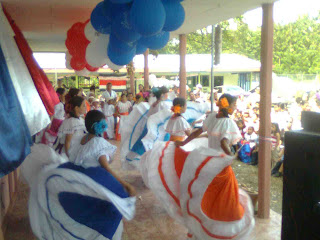
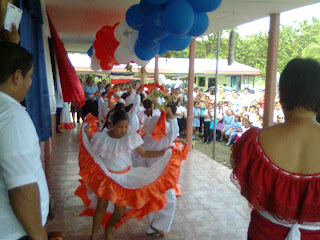
The next day was Independence Day, and I was astonished that everything went off without a problem. We sang the 'Salute to the Flag' and then the 'National Anthem' and then 'Hymn to September 15th' and then the 'Hymn to Juan Santamaría' and then 'Hymn to the Battle of Santa Rosa', those last apparently two just to amp up the level of nationalism at the event, since we had already celebrated those days. All of the songs are beautiful, and the lyrics are quite moving, but they are played far too frequently, and the medley goes on for about 7 minutes too long. The dances were my favorite part of the ceremony, it made me so proud to see my students performing complicated movements, and swishing their long dresses around. I had gone to the first practice to set up the music for the teacher, and seeing how much they improved in such a short time was thrilling. The poetry was adorable, especially when the kindergartner's goggled at the audience and tripped through their lines, even then some of them seemed like trained actors compared to the third grader's stammering stage fright. The ceremony ended with another round of patriotic songs, and everyone went off home.
The most surprising part of all the ceremonies was how little most participants seemed to actually feel patriotic. The songs were sung half-heartedly, less than half of the parents managed to stop their conversations during the national anthem, even fewer knew the words to any of the patriotic songs. In a country with as many things to be proud of as Costa Rica (gorgeous wildlife, a strong democracy, no armed forces, the strongest economy in Central America, a strong system of national parks, etc.) it is odd that displays of patriotism should seem so antiquated and feel so forced. Watching the empty pageantry of another country's nationalism made me realize again how proud I am to be an American.
*Another reason is that we don't usually change the spelling of months - Costa Rica's Royal Academy of Spanish recently pushed through the spelling 'Setiembre' for 'Septiembre'.
Thursday, September 8, 2011
Corcovado: soap no, refried beans yes
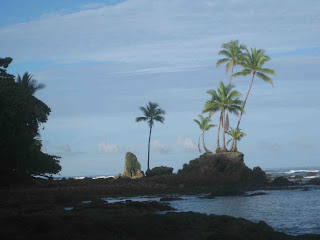
Waking up at three in the morning seemed a blessed relief after spending several hours delicately avoiding tossing and turning while jackknifed into a poorly-hung hammock. This was especially true because Kristen and I then stumbled out to the street to begin the long taxi-ride out to Karate to start our trek into one of the most bio-diverse and secluded primary forest reserves in the world.
We were heading to Corcovado National Park, home of tapirs and peccaries, jaguars and mountain lions, tinamous and sparrows, coatis and raccoons, monkeys and armadillos, agouti and squirrels, alligators and rattlesnakes, osprey, pelicans, and harpy eagles. There are more, but the combination between the exotic and the normal (for a Californian) is rather startling at first. We rarely imagine our tawny mountain lion sharing a range with the majestic jaguar, much less slowly replacing it, yet precisely here North America and South America combine and intermix, and 2.5 Million years after their first meeting the intercontinental species swap is still taking place in southern Costa Rica.
After a several hours in the taxi we emerged at an airstrip on a rather desolate looking stretch of rocky beach. The misty rain that came rippling across the ocean was rather different from the steamy sunrise we feel in our part of the Peninsula, but for the long stretch of beach walking ahead of us it would hard to imagine better weather. As we climbed into the jungle the sun emerged and shone upon our first exotic animal, a poison dart frog! Since then I have seen them at my bus stop and around my schools, but the first viewing is always a wonderful experience. As we trekked through the thickening trees the humidity and heat turned our shirts into sweltering swamps, weighing easily 10 pounds. It was around this time that I realized my water bottle had turned over inside my backpack and slowly emptied out all of the water into my belongings. This was unfortunate for several reasons: first, I was left without water, and second, everything I had brought and not sealed was wet. These both were ultimately minor inconveniences. After several returns to the beach we hit a long stretch of sun and sand, and halfway along water sprung from the cliffs. We were told it was the last water until the Station we would stay at, so I was lucky enough to fill up again and not suffer much thirst.
We had been hiking rather fast, and as we got close to the station we discovered why. We had arrived at a river, not one of the many streams we had already successfully passed but a growing estuary just upstream from the river mouth. The ford was at least 300 feet across and the water quite murky. Our guide told us that every second that passed the water level was rising, so Kristen and I immediately pulled our shoes off, hiked up our pants, and got ready to hoist our bags over our heads, when I asked if there were Crocodiles or Alligators. The guide remained silent as if he hadn't heard us, so Kristen and I started in. I was warily eying the opposite bank and the water all around us, but the more I stubbed my toe on rocks the more I forgot to be scared of aquatic reptiles. Soon we had all crossed successfully, the water only slightly above our waists at the deepest. Once we had all gathered at the other side our guide drew me aside and said simply 'Yes.'
Once we arrived at the station we found that the camping took place on a wood floor elevated about 7 feet off the ground under a roof and connected to the station itself. It was a lot better than I had expected. The station itself was situated at the end of a grassy airstrip with a large well tended lawn, and immediately towering tropical trees jungle jutted up on all sides.
That night we hiked out to another estuary to search for Tapirs, we sat on the riverbank and entertained ourselves by staring at eddies and whirls, playing with hermit crabs, watching various hawks and egrets, and hoping in vain that a large Tapir would come strolling out of the trees and pose on the bank. As the sun sunk into the storm clouds out over the Pacific we began to walk back along the beach. Suddenly, our guide dropped into a crouch behind a log, and began scuttling forward making signs for us to follow quietly. This was very hard to accomplish, and by the time everyone had started to quiet down and look around the tapir had darted back into the forest. Our guide plunged after it, and soon we stumbled upon a mother and baby tapir feeding in a gully. Tapirs are large, with incredibly thick skin, sort of a mix between a rhino and a pig, with a long movable snout that is a little like a short elephant's trunk. The baby was about two years old, and had a massive head. Both tapirs were unconcerned by our presence, aside from a slow moving grazing and occasionally tilting their snouts in our direction and snuffling it was as though we were not there. We got back and ate our hearts out, then turned in.
I woke up early and started off into the forest along a short path we had taken the day before. As I walked forward off the airstrip the trees gradually closed in around me and I was fully alone, engulfed in my surroundings, and set adrift in my appreciation of the natural world. The 'jungle' here is not thick with underbrush requiring a machete to move forward. It is not truly jungle either, but rather 'primary moist forest', and the best comparison (it is in fact incredibly similar) is a broilingly hot and humid version of the coastal redwoods in Northern California. in every direction but up open space abounds, interrupted by the occasional bush, small tree, or dangling vine. The forest floor is dappled with leaves and mud, but not swamped by either. The main difference is the ubiquitous presence of monkeys and large parrots, who move with anything but silence and care through the canopy. Forests are often described as Cathedrals, and I can find no better metaphor for the instant respect and reverence that standing in the forest produces. The trees rise mind-boggling heights, their bases buttressed by thick, winding, roots that are taller than people, the sunlight filters down through a thick kaleidoscope of stained leaves and the howler monkeys and tinamous create an eerie, beautifully harmonized choir of gargoyles that explodes through the early morning air. It was magnificent and supremely beautiful.
That afternoon we took a longer hike through the rainforest, and I became pretty good at spotting monkeys (the trick is to wait until you hear a branch hit the ground, then look up). Spider monkey babies, for the record, are adorable. And the fearless leaps their mother's take with little ones hanging on to their backs made me gasp more than once. Howler Monkeys are pretty ugly, but manage to convey a sense of wisdom in their piercing gaze. Sloths are devilishly hard to spot (although my Aunt was very good at it when she came to visit), and wear an expression of perpetual confusion. The cutest animal by far however, was the tamandua, a type of anteater that we saw climbing around in a tree during the hike out. The soles of it's feet are bright pink, and it combed the tree thoroughly, just as frequently upside-down as right-side-up. Watching it stretch its long claws to clasp a new branch was beautiful, if the moment when it suddenly unbalanced and swung forward was startling.
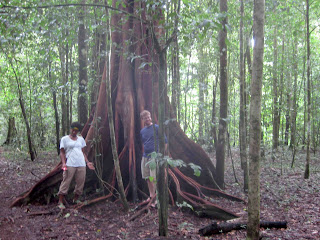 The next morning (my birthday) we started out early and met with a herd of small red brocket deer grazing on the lawn as the newly risen sun lit the delicate mist rising from the grass. As we continued bleary-eyed down the airstrip an iron-flanked and rather un-bellowing he-Tapir clanked and battered across the grass towards us. Pausing momentarily when he heard us, he continued trudging into high grass and the forest, soon lost to view except for the waving tufts of grass billowing in his wake. I thought, Happy Birthday Barton! and kept walking.
Subscribe to:
Posts (Atom)