These past few weeks I have been captivated by 'El Gran Reto Centroamericano de Baile!' This is a a Central American dance competiton along the lines of Dancing for the Stars. They take the two finalists from each national version of 'Bailando por un Sueño' and then they dance every Sunday for six weeks, and the group with the highest score wins. So far Costa Rica had been winning every competition, but now the Salvadoran and Honduran judges seem to be purposefully scoring them low to give their own country's teams a chance. I think what I most like about the 'Reto' is that it is one of the few ways that Central American mass media gets to show how much Central America has in common.
In part, this is fun to watch because its nice to sit together with the whole family and all talk about the same thing, in part its fun to watch because of the incredibly pageantry, and in part its amazing to watch because of the absurdity of the whole thing. The winners also receive a $25,000 prize. The prize confuses me a little, because by all rights the participants should be content with increasing their national pride, and not need a little bribe (especially since both Costa Rican participants are fairly wealthy TV personalities/announcers). So far only two teams have said they would donate their money to charity (the other teams say they will go to Hawaii, or buy a new house, or buy more clothes).
Tonight we are watching the teams perform Samba and Tango in Honduras, and it has so far been pretty exciting. Especially because for once the Honduran judge didn't give his team a nine or a ten, he gave them a seven! Samba is enjoyable because of the Carnival costumes. Tango is fun because no one can dance it convincingly, and because the music is fun to listen to.
This seems like an odd place to add that now we have two indigenous High School students living with us, because from here they can catch a bus to the school, instead of having to hike down from the mountains three to four hours every school-day. They are quiet, but very nice, and I liked them straight off because they were sweet to my(?) dog from the moment they arrived, unlike most Costa Ricans who are either merely tolerant, or violent towards dogs (my host uncle tries to kick every dog he sees, and I stopped him with a glare from doing the same to 'Malta'). The indigenous kids watch the 'Reto' with us too, and that brings everyone together as well.
Whenever the neighbor's two year-old realizes that we are watching people dance she spins around in circles in front of the TV giggling until she falls over. She just nailed a very convincing splits.
Uh-oh! Here comes Costa Rica, "Tres... Dos... Uno.. RETO!"
Sunday, February 20, 2011

Rain Like Thunder
I started class last week, and its been absolutely exhausting. On Monday I rode my bike to a small unidocente school, which means the school has one teacher for 1st through 6th grade, and in this case, another for kindergarten. When I pulled up on my bicycle (after the harrowing bridge crossing) the school was full of cows. A few frightened students and I stood at the end of the driveway, until I decided to walk my bike by the cows (and a rather large and terrifying bull) and nothing happened. It wasn't until a father came to drop his kid off and began throwing rocks and dirt clods at the cows that they started trotting away. Apparently the neighboring farms put their animals to graze there on weekends because its cheap pasture. I've been on a bus in traffic for fifteen minutes waiting for someone to clear those same cows from the road. Class was even more exciting than that though, especially because it was my first time teaching in a school! The teacher started class with a prayer and the national anthem, and then turned the class over to me. We talked about greetings and basic conversation, and that is basically what I've gone over with all of my classes.
In every class so far I have made a point of asking each student's name individually. Since I will be working with over 200 students across five days, I probably will not learn their names for a long time, but that has become one of my personal goals. On tuesday and wednesday I went to what I consider 'my' school. Its the one my host mother works at, and the one that is in my town, and the biggest one. Most importantly, its the only school where the children see me outside of class. Yesterday, on my way to the beach at least ten different kids said either "hola profe" or "hello teacher", which brightened my day considerably. At this school three grades come in the morning, and three grades come in the afternoon, so my longest day lasts from 7 in the morning to 5 in the afternoon.
At my other school (a substantial bus ride away), the classes are organized so that in the morning fifth and sixth are in one room, and third and fourth are in the other room. First and second come in the afternoon and are each in a different room. I found out that one of the teachers is either the most interesting person in Osa, or the best liar for miles around. He told me that the school was built by American troops in 1964, and aside from being a teacher he is a notary and a lawyer, and his office is across the street. At one point while I was teaching sixth grade, he was teaching fifth, and he interrupted class to meet with a client. He also told me that he studied Medicine in Armenia while it was part of the Soviet Union, but had to stop when the university was destroyed in an earthquake. When he came back to Costa Rica he studied Law and Education at the same time, and now he is a few years from retirement as a teacher, but he'll stay a lawyer. His dream is to argue a case in Rome, 'the birthplace of law'.
As I was writing this a rain-storm swept through my neighborhood. I was sitting on the porch (the coolest place in the house) and slowly as the sky darkened I began to hear a low, dull, roar. Like a truck engine miles away. It grew steadily louder, until I heard waves were crashing just behind the line of trees across the road. Then the leaves start shaking, and a roar like thunder breaks out from behind the field. The rocks on the road in front of the house start jumping, and all of a sudden the thick plodding of rain on a metal roof fills the house, and no one can hear anything until the storm passes. Least of all my host father trying to watch his soccer game.
In every class so far I have made a point of asking each student's name individually. Since I will be working with over 200 students across five days, I probably will not learn their names for a long time, but that has become one of my personal goals. On tuesday and wednesday I went to what I consider 'my' school. Its the one my host mother works at, and the one that is in my town, and the biggest one. Most importantly, its the only school where the children see me outside of class. Yesterday, on my way to the beach at least ten different kids said either "hola profe" or "hello teacher", which brightened my day considerably. At this school three grades come in the morning, and three grades come in the afternoon, so my longest day lasts from 7 in the morning to 5 in the afternoon.
At my other school (a substantial bus ride away), the classes are organized so that in the morning fifth and sixth are in one room, and third and fourth are in the other room. First and second come in the afternoon and are each in a different room. I found out that one of the teachers is either the most interesting person in Osa, or the best liar for miles around. He told me that the school was built by American troops in 1964, and aside from being a teacher he is a notary and a lawyer, and his office is across the street. At one point while I was teaching sixth grade, he was teaching fifth, and he interrupted class to meet with a client. He also told me that he studied Medicine in Armenia while it was part of the Soviet Union, but had to stop when the university was destroyed in an earthquake. When he came back to Costa Rica he studied Law and Education at the same time, and now he is a few years from retirement as a teacher, but he'll stay a lawyer. His dream is to argue a case in Rome, 'the birthplace of law'.
As I was writing this a rain-storm swept through my neighborhood. I was sitting on the porch (the coolest place in the house) and slowly as the sky darkened I began to hear a low, dull, roar. Like a truck engine miles away. It grew steadily louder, until I heard waves were crashing just behind the line of trees across the road. Then the leaves start shaking, and a roar like thunder breaks out from behind the field. The rocks on the road in front of the house start jumping, and all of a sudden the thick plodding of rain on a metal roof fills the house, and no one can hear anything until the storm passes. Least of all my host father trying to watch his soccer game.
Sunday, February 6, 2011
Bicycle!
A few days ago I took the ferry across the bay and bought a bike! This has produced a massive change in my lifestyle here, and with school ramping up I no longer have to fear taking the (expensive) bus six kilometers to one of my schools.
One of the most exciting (if least productive) changes is that I can head to the beach at practically any time, and its a pretty short distance. Distance is measured in time in Costa Rica, and I never bring my watch so I'm not sure exactly how long, but I can do a pleasurable beach trip that includes swimming in a little over an hour. I've also found a nice route that takes me a pretty good distance from home, but provides excellent birding opportunities as well as stunning vistas of the hills that jut up from the fields.
The trip to get the bike was pretty exciting, it included taking boats across the gulf. The boat ride back was overcrowded and rough, and the flew into the air on every wave, and then the bottom slapped the surface of the water, while spray flew in through the open front windows. Ultimately it was worth it though, because I saw a sea turtle from the pier, and sea turtles are adorable. Upon landing we began hefting unassembled bicycles in boxes across Puerto Jimenez, and onto the overcrowded 4:30 bus. I should note that this bus, and most buses on Osa (2 of the 3) are unmodified US School Buses. They are frequently crowded, and that usually makes seated people in front start yelling at people in the back to make more room so that the bus can start going, even though the people in back are packed in like sardines. Today it was even worse, because aside from the normal bags of animal feed (and the strangely ever present weed-whacker) there were two bike boxes. Right about when we got to my friend's site the police stopped the bus, and said that there were too many people on it. I am still sure what this was supposed to accomplish, because they did not offer to shuttle us home in the police car, merely informed us that the bus was too full and could not continue. After a few minutes of argument the bus driver probably swore he would not do it again, and we could get under way. During that time my friend and I tried to get the bike off the bus, and found that we had to use the emergency exit hatch on the back, since there was a solid wall of people between us and the back door. The Police captain helped us lower the bike, and my friend leaped down and ran to pay the bus driver before the mutinous passengers forced him to drive away. Forty-five minutes later when the bus got to my stop it was no less crowded, and I found to my chagrin that no one was willing to help me lift and hold the box for the few seconds between jumping out of the hatch, and lowering the bike off the bus. This resulted in confusion when the precariously balanced box began falling back into the other passengers before I could turn around and grab it. I still feel pretty bad about this, but no one was injured or even remotely crushed, and I managed to pay the driver before one of my neighbors even managed to push her way off the bus, so I didn't even hold anyone up. I hope.
I wear a helmet every time I get on my bike, as per Peace Corps regulation, and yesterday one of my English students borrowed a bike from my house and with the help of her friends began to learn how to ride. She kept riding by to show how fast she learned, but I was most pleased to see that aside from being an excellent bike rider, she was also wearing a helmet.
One of the most exciting (if least productive) changes is that I can head to the beach at practically any time, and its a pretty short distance. Distance is measured in time in Costa Rica, and I never bring my watch so I'm not sure exactly how long, but I can do a pleasurable beach trip that includes swimming in a little over an hour. I've also found a nice route that takes me a pretty good distance from home, but provides excellent birding opportunities as well as stunning vistas of the hills that jut up from the fields.
The trip to get the bike was pretty exciting, it included taking boats across the gulf. The boat ride back was overcrowded and rough, and the flew into the air on every wave, and then the bottom slapped the surface of the water, while spray flew in through the open front windows. Ultimately it was worth it though, because I saw a sea turtle from the pier, and sea turtles are adorable. Upon landing we began hefting unassembled bicycles in boxes across Puerto Jimenez, and onto the overcrowded 4:30 bus. I should note that this bus, and most buses on Osa (2 of the 3) are unmodified US School Buses. They are frequently crowded, and that usually makes seated people in front start yelling at people in the back to make more room so that the bus can start going, even though the people in back are packed in like sardines. Today it was even worse, because aside from the normal bags of animal feed (and the strangely ever present weed-whacker) there were two bike boxes. Right about when we got to my friend's site the police stopped the bus, and said that there were too many people on it. I am still sure what this was supposed to accomplish, because they did not offer to shuttle us home in the police car, merely informed us that the bus was too full and could not continue. After a few minutes of argument the bus driver probably swore he would not do it again, and we could get under way. During that time my friend and I tried to get the bike off the bus, and found that we had to use the emergency exit hatch on the back, since there was a solid wall of people between us and the back door. The Police captain helped us lower the bike, and my friend leaped down and ran to pay the bus driver before the mutinous passengers forced him to drive away. Forty-five minutes later when the bus got to my stop it was no less crowded, and I found to my chagrin that no one was willing to help me lift and hold the box for the few seconds between jumping out of the hatch, and lowering the bike off the bus. This resulted in confusion when the precariously balanced box began falling back into the other passengers before I could turn around and grab it. I still feel pretty bad about this, but no one was injured or even remotely crushed, and I managed to pay the driver before one of my neighbors even managed to push her way off the bus, so I didn't even hold anyone up. I hope.
I wear a helmet every time I get on my bike, as per Peace Corps regulation, and yesterday one of my English students borrowed a bike from my house and with the help of her friends began to learn how to ride. She kept riding by to show how fast she learned, but I was most pleased to see that aside from being an excellent bike rider, she was also wearing a helmet.
English Class
A trickle of sweat glides down my back as I turn away from the chalk board. As I slowly sound out 'rest-er-ont' I am silently chastising myself for hanging the board up in the sunlight weeks ago. Today the heat is getting to almost everyone. The cadre of adult students who come early to snag seats on the floor under the slight shade of the waist-high wall are too hot to be talking and giggling, and for once the kids sitting on the benches are not following my every move with rapt attention. 'Ok, pasamos al siguiente.' Content with their pronunciation, my caffeine infused hands shake as they write 'Hotel' up on the board. Its a short word, so none of the letters collapse into poor chalksmanship. As they write the word into their notebooks I say it twice. Then when everyone is again paying attention I say 'Ho... Ho... HO... Tellll... Telll...Ho-tellll'. As a chorus of Ho's greets my ears I fail to stifle a chuckle.
Pronunciation is very fun for me to teach, and everyone seems to enjoy it. Whether it consists of the students holding a finger in front their mouths, and "blowing out the candle" while pronouncing p (in hoss-Pitt-uhl), or learning the difference between the s in 'police' and the s in 'is' (demonstrated by having everyone touch their throats for the pronunciation of both), it is wonderful to hear pronunciation improving so rapidly, and it is fascinating to break down words into the way that they are said, instead of the way they are spelled.
So far the course has been meandering through basic phrases and questions that would be most common from tourists (greetings, time, buying and selling, directions, etc.). Also, we've been struggling through numbers. Altogether it was probably much to early to spring numbers on them, but with a little review in each class and few more lessons later on, I hope to have them down before long. The currency of Costa Rica (500 colones (literally 'Columbuses' is roughly one dollar) make large numbers imperative, so I am not content with just doing 1-20. Unfortunately the word 'Thousand' is a pronunciation minefield, since the th the ou and the voiced s are sounds that do not naturally occur in Spanish, and much less so close together.
Overall, I feel as though we have made a good start, and hopefully the class will continue showing up once school starts (February 10th).
Pronunciation is very fun for me to teach, and everyone seems to enjoy it. Whether it consists of the students holding a finger in front their mouths, and "blowing out the candle" while pronouncing p (in hoss-Pitt-uhl), or learning the difference between the s in 'police' and the s in 'is' (demonstrated by having everyone touch their throats for the pronunciation of both), it is wonderful to hear pronunciation improving so rapidly, and it is fascinating to break down words into the way that they are said, instead of the way they are spelled.
So far the course has been meandering through basic phrases and questions that would be most common from tourists (greetings, time, buying and selling, directions, etc.). Also, we've been struggling through numbers. Altogether it was probably much to early to spring numbers on them, but with a little review in each class and few more lessons later on, I hope to have them down before long. The currency of Costa Rica (500 colones (literally 'Columbuses' is roughly one dollar) make large numbers imperative, so I am not content with just doing 1-20. Unfortunately the word 'Thousand' is a pronunciation minefield, since the th the ou and the voiced s are sounds that do not naturally occur in Spanish, and much less so close together.
Overall, I feel as though we have made a good start, and hopefully the class will continue showing up once school starts (February 10th).
Thursday, January 13, 2011
Poultry in Stasis
[Warning: Graphic description of preparing chickens below]
I may have failed to mention that my new host father raises chickens. I have gotten used to the smell, and I no longer think they are the ugliest creatures imaginable, but I am only now starting to become involved in the process of preparing them. I fetch water, or tend the wood stove, but a few days ago I got to help 'peel' them. It was the day before New Year's Eve, and he had sold fifteen chickens to people (and restaurants) in anticipation of a feast to welcome in the new year.
The first step in this process is to kill the chickens. This is done further away from the house (across the ditch where all the sewage flows) and the chickens are placed upside down into a vise. They don't tend to protest, until after the head is cut cleanly off. Then the body starts jerking every which way, and if the wings were not secured it would be very difficult to keep hold of the bird. After a while it stops moving, and blood stops gushing. The aftermath was pretty gruesome, fifteen decapitated chicken corpses twitching in a rusty wheelbarrow with a few large dollops of blood splattered around. Next the chickens are hoisted one by one out of the wheelbarrow by their scaly feet and dropped unceremoniously into a giant pot of hot water. The water cannot be boiling, because then the chicken would get cooked, but it can't get too cold either or else the feathers would still be unpluckable, so my host father tends to the flames while my host mother and the neighbor put on aprons and stand behind a long wooden table near the chicken enclosures. This entire process, I should add, takes place in full view of the other 300 chickens that await a similar fate.
After about thirty seconds in the hot water the chicken is pulled out (again by the feet) and brought to the table. Then my host mother and the neighbor begin peeling handfuls of feathers off the soggy birds. This is where I came in (after fetching random implements and beverages). Pulling the feathers off a warm, wet, dead chicken is not terribly difficult, what is difficult is pulling all the feathers off. The back and belly are easily de-feathered, the wingtips required knives or pliers. But turning the chicken back over one is surprised to find hundreds of little feathers, almost like hairs, springing up from what was previously a fully plucked chicken. I saved the neck for last, touching bloody feathers was almost too much.
Next I got to watch my neighbor clean one chicken, but then my host mother sent me inside to make more coffee. The most surprising thing I learned about chickens is that their feet are soft and fleshy, not sheathed in hard yellow scales. The smell was overpowering, a mix between wet dogs and mold, and it was hard to get the stench off my hands, even with veterinarian's alcohol. The grilled chicken we had for dinner was excellent.
[Addendum] Today two chicks had to be killed because they were diseased, and aside from never growing into chickens would infect all the others. After they wandered around out of the pen for a while the puppies took and interest in them, chewed on their wings, and played tug-of-war with them. To 'put them out of their misery' my host mom picked up a long 2x4, flipped one chick on its back, and dropped one end of the board on its head. I was completely unprepared for this, although I was able to watch the second time, and it was pretty awful.
I may have failed to mention that my new host father raises chickens. I have gotten used to the smell, and I no longer think they are the ugliest creatures imaginable, but I am only now starting to become involved in the process of preparing them. I fetch water, or tend the wood stove, but a few days ago I got to help 'peel' them. It was the day before New Year's Eve, and he had sold fifteen chickens to people (and restaurants) in anticipation of a feast to welcome in the new year.
The first step in this process is to kill the chickens. This is done further away from the house (across the ditch where all the sewage flows) and the chickens are placed upside down into a vise. They don't tend to protest, until after the head is cut cleanly off. Then the body starts jerking every which way, and if the wings were not secured it would be very difficult to keep hold of the bird. After a while it stops moving, and blood stops gushing. The aftermath was pretty gruesome, fifteen decapitated chicken corpses twitching in a rusty wheelbarrow with a few large dollops of blood splattered around. Next the chickens are hoisted one by one out of the wheelbarrow by their scaly feet and dropped unceremoniously into a giant pot of hot water. The water cannot be boiling, because then the chicken would get cooked, but it can't get too cold either or else the feathers would still be unpluckable, so my host father tends to the flames while my host mother and the neighbor put on aprons and stand behind a long wooden table near the chicken enclosures. This entire process, I should add, takes place in full view of the other 300 chickens that await a similar fate.
After about thirty seconds in the hot water the chicken is pulled out (again by the feet) and brought to the table. Then my host mother and the neighbor begin peeling handfuls of feathers off the soggy birds. This is where I came in (after fetching random implements and beverages). Pulling the feathers off a warm, wet, dead chicken is not terribly difficult, what is difficult is pulling all the feathers off. The back and belly are easily de-feathered, the wingtips required knives or pliers. But turning the chicken back over one is surprised to find hundreds of little feathers, almost like hairs, springing up from what was previously a fully plucked chicken. I saved the neck for last, touching bloody feathers was almost too much.
Next I got to watch my neighbor clean one chicken, but then my host mother sent me inside to make more coffee. The most surprising thing I learned about chickens is that their feet are soft and fleshy, not sheathed in hard yellow scales. The smell was overpowering, a mix between wet dogs and mold, and it was hard to get the stench off my hands, even with veterinarian's alcohol. The grilled chicken we had for dinner was excellent.
[Addendum] Today two chicks had to be killed because they were diseased, and aside from never growing into chickens would infect all the others. After they wandered around out of the pen for a while the puppies took and interest in them, chewed on their wings, and played tug-of-war with them. To 'put them out of their misery' my host mom picked up a long 2x4, flipped one chick on its back, and dropped one end of the board on its head. I was completely unprepared for this, although I was able to watch the second time, and it was pretty awful.
Sunday, December 26, 2010
A site for sore eyes?
I have been in my site for a week now, and I feel as though I am finally settling into the rhythms of life here. Above all, it is hot. A cold shower feels refreshing at seven in the morning. Merely reading in the shade can provoke rivulets of sweat down my cheeks. Incidentally, reading in the shade has been my favorite pastime, I downed five books this week (not counting manuals on teaching English).
On Christmas we went to a long sandy beach, and had a barbecue. The tides here feel far too drastic, the mermaid statue which was 15 feet tall and surrounded by as much dry land when we arrived was only five feet fall and standing in the middle of ocean by the time we left. Also we went kayaking a deceptively long distance, and started to paddle out over what has been called the third deepest trench on the planet. I have been unable to corroborate this, but I love the story that always accompanies it: Jacques Cousteau came and lowered a sounding rope, but he ran out of rope before he touched bottom! Its really anticlimactic and fails to prove anything. I have heard this story about seven times from about five different people. The really good news though, is that whales apparently come here to give birth, and there are fantastic places nearby with sweeping vistas of the entire gulf (Golfo Dulce).
In Puerto Jimenez I finally saw Basilisk lizards (and Caimans). We tried to make them run on top of the water, but they were having none of it until suddenly one jumped off a log and ran all the way to the shore (three feet) along the surface of the water. It was incredible.
P.J. is the nearest large town to my site, and it is also 'the portal to Corcovado' a prime backpacking/ecotourist location. This means that the supermarket there is tailored to far different tastes than most Costa Rican markets. They have almost a full complement of spices, bamboo chutes, curry paste, and SPAM. I know it cannot get much more exciting than SPAM, but they also have amazing ice cream, including the amazing flavor 'Ron y Pasas'.
I'll be teaching an English class to some community members the second week of January, so I'm now deeply ensconced in planning and reading on how to teach community based classes. Hopefully it will be successful!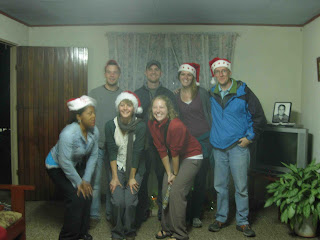
[This picture is of my friends from the training community when we went Christmas Caroling a few days before we headed to our sites. It was both fun and surprising for all the Costa Rican host families we visited.]

On Christmas we went to a long sandy beach, and had a barbecue. The tides here feel far too drastic, the mermaid statue which was 15 feet tall and surrounded by as much dry land when we arrived was only five feet fall and standing in the middle of ocean by the time we left. Also we went kayaking a deceptively long distance, and started to paddle out over what has been called the third deepest trench on the planet. I have been unable to corroborate this, but I love the story that always accompanies it: Jacques Cousteau came and lowered a sounding rope, but he ran out of rope before he touched bottom! Its really anticlimactic and fails to prove anything. I have heard this story about seven times from about five different people. The really good news though, is that whales apparently come here to give birth, and there are fantastic places nearby with sweeping vistas of the entire gulf (Golfo Dulce).
In Puerto Jimenez I finally saw Basilisk lizards (and Caimans). We tried to make them run on top of the water, but they were having none of it until suddenly one jumped off a log and ran all the way to the shore (three feet) along the surface of the water. It was incredible.
P.J. is the nearest large town to my site, and it is also 'the portal to Corcovado' a prime backpacking/ecotourist location. This means that the supermarket there is tailored to far different tastes than most Costa Rican markets. They have almost a full complement of spices, bamboo chutes, curry paste, and SPAM. I know it cannot get much more exciting than SPAM, but they also have amazing ice cream, including the amazing flavor 'Ron y Pasas'.
I'll be teaching an English class to some community members the second week of January, so I'm now deeply ensconced in planning and reading on how to teach community based classes. Hopefully it will be successful!

[This picture is of my friends from the training community when we went Christmas Caroling a few days before we headed to our sites. It was both fun and surprising for all the Costa Rican host families we visited.]
Friday, December 10, 2010
All my troubles will be out of site
I came back from my site visit on Wednesday, and not even a hot and sweaty eight hour bus ride could shake my overwhelming happiness at the place I will be living for the next two years. Glorious is too small a word to describe a walk to school where toucans and scarlet macaws flutter through the sky, while cows and water buffalo graze between rice paddies. Gorgeous does not adequately demonstrate the ocean's sudden appearance between the trees a mere twenty minute walk from my house. Gracious cannot capture a host family who are quite humble, but insist on sharing everything they have.
I am gushing, but there is little other recourse. Osa seems in many ways a land that time forgot, and then suddenly remembered just last year. There has never been a telephone system (even now), but they have free wireless internet at one of my schools, and a 3G network for the entire peninsula. The roads have always been awful, until they built an American style highway last year that connects precisely the towns I will need to go to; but not, incidentally, the rest of Costa Rica.
On Monday the school had a dinner for graduating sixth graders, and since my host mom is the school cook, and because I helped the teacher make decorations earlier in the day, I was invited to introduce myself to the community and the students. I won't say that I had remarks prepared, but it would not have mattered because the DJ disappeared and left reggaeton on full blast, so the teacher had to use the karaoke microphone to make herself heard. No one seemed phased by this in the least. What shocked them was that after shaking all of the student's hands I immediately set about helping my host mom (and aunt and cousin, who had shown up for the same days as my visit) serve food, violating apparently rigid gender norms. It was fun, and both my host cousin and the teacher had promised to teach me to dance pachata, but the DJ seemed determined to force the sixth graders to dance reggaeton, so soon two circles formed (boys and girls) and began shifting almost in beat, while the teacher danced from student to student, embarrassing them in front of their parents.
Now I am back in my training community, and the Christmas spirit has hit me in full force (as well as really cold weather, and even colder showers). I'm fighting it off with a warm inner glow, remembering the heat of the south, and knowing that soon I will be a real volunteer.
(This picture is looking down the road from the school at the "city center")

I am gushing, but there is little other recourse. Osa seems in many ways a land that time forgot, and then suddenly remembered just last year. There has never been a telephone system (even now), but they have free wireless internet at one of my schools, and a 3G network for the entire peninsula. The roads have always been awful, until they built an American style highway last year that connects precisely the towns I will need to go to; but not, incidentally, the rest of Costa Rica.
On Monday the school had a dinner for graduating sixth graders, and since my host mom is the school cook, and because I helped the teacher make decorations earlier in the day, I was invited to introduce myself to the community and the students. I won't say that I had remarks prepared, but it would not have mattered because the DJ disappeared and left reggaeton on full blast, so the teacher had to use the karaoke microphone to make herself heard. No one seemed phased by this in the least.
 What shocked them was that after shaking all of the student's hands I immediately set about helping my host mom (and aunt and cousin, who had shown up for the same days as my visit) serve food, violating apparently rigid gender norms. It was fun, and both my host cousin and the teacher had promised to teach me to dance pachata, but the DJ seemed determined to force the sixth graders to dance reggaeton, so soon two circles formed (boys and girls) and began shifting almost in beat, while the teacher danced from student to student, embarrassing them in front of their parents.
Now I am back in my training community, and the Christmas spirit has hit me in full force (as well as really cold weather, and even colder showers). I'm fighting it off with a warm inner glow, remembering the heat of the south, and knowing that soon I will be a real volunteer.
(This picture is looking down the road from the school at the "city center")

Subscribe to:
Posts (Atom)